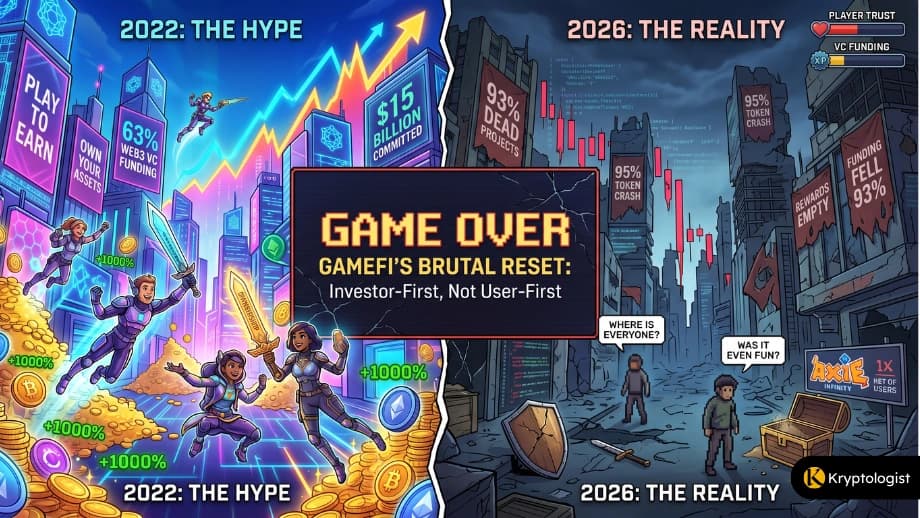
Somewhere in 2022, the pitch made perfect sense. Games would no longer just entertain you — they would pay you. You would own your swords, your land, your characters outright, and you could sell them. Venture capital agreed enthusiastically: at the peak, blockchain gaming pulled in roughly 63% of all Web3 venture funding.
Four years later, that bet has effectively been called. A report from market-making firm Caladan, analyzing more than 3,200 blockchain gaming projects, concludes that around 93% of GameFi projects are now effectively dead — no meaningful users, abandoned development, or dissolved teams. Token prices across the sector are down roughly 95% from their 2022 highs. Funding to studios fell about 93% from its peak.
The headline number — up to $15 billion committed to the sector since 2020 — is the one that travels. But the number isn't the story. The story is how a sector with that much capital and that much hype managed to lose almost all of it.
What the report actually found
Caladan's analysis covers 2020 through early 2026, and a few data points are worth sitting with rather than skimming past.
The flagship case is Axie Infinity. At its 2022 peak it had roughly 2.7 million daily active users; reporting now puts that figure in the low thousands. Yield Guild Games' token, once the symbol of the "play-to-earn guild" economy, trades more than 99% below its late-2021 high. The Telegram tap-to-earn wave — Hamster Kombat and its peers — pulled in hundreds of millions of users and then shed the vast majority of them within months.
Caladan's own summary line is blunt: capital was destroyed "at every layer simultaneously" — venture funds, retail NFT buyers, gaming guilds, and tap-to-earn apps all hit in the same cycle. By May 2025, a single small funding round reportedly represented the entire global sector's funding for the month.
A note on the figures: estimates of total capital committed range from about $12 billion to $15 billion depending on what's counted, and the "93% dead" figure echoes earlier sector studies from other research groups. We're treating these as a credible convergent estimate, not a precise audited number — and you should too.
The design flaw underneath the crash
It's tempting to write this off as just another crypto bear market. That explanation is too easy, and it's the part most coverage gets lazy about.
A bear market explains why token prices fell. It does not explain why the games themselves had no players to fall back on. Even at the absolute peak of the mania, only around 12% of gamers had ever tried a crypto game, according to survey data cited in the report. The demand was never really there — the capital just arrived as if it were.
That's the actual flaw, and it's structural. The play-to-earn model turned a game into a financial loop: buy in with tokens or NFTs, earn rewards in those same assets, cash out — as long as new buyers keep arriving. When inflows slow, rewards thin, players leave, and the in-game economy unwinds. It is a growth-dependent system wearing a video game as a costume.
The funding pattern made it worse. Studios raised tens or hundreds of millions before shipping a product, which quietly removed the one pressure that makes games good: the need to build something people will play for fun. One frequently cited example raised around $70 million in a 2022 NFT mint and, years later, still had no public game. Meanwhile, real game development takes three to five years — but the tokens traded in real time and needed constant momentum. Many tokens had already collapsed before the game they were attached to was even finished.
Our framing for this, and the through-line of this piece: GameFi was built investor-first, not user-first. Almost everything else follows from that.
Is any of it still alive?
Yes — and this is where the wholesale "Web3 gaming is dead" headlines overshoot.
The signals are genuinely mixed. Some gaming tokens posted sharp percentage gains in early 2026, though largely because they were rebounding from near-zero. A handful of titles that prioritized actual gameplay over tokenomics — Gunzilla's Off the Grid is the example that comes up most — have made it to real public release and are getting real traction. And the sector's most prolific backer, Animoca Brands, hasn't exited gaming entirely; it has cut pure gaming to roughly a quarter of its portfolio and rotated the rest toward stablecoins, tokenization, and AI.
Read honestly, that's not a corpse. It's a reset — a brutal one. The technology question ("can you give players genuine ownership of game assets?") was never really the thing that failed. The economic model bolted onto it was.
What this means if you're a player or a builder
For players: the lesson is the oldest one in consumer protection, and it applies cleanly here. If a game's primary pitch is the earning and not the playing, treat the token as a speculative asset, not a paycheck — and assume the people who designed the economy understand its exit dynamics better than you do. (Nothing in this article is financial advice; it's a description of how these systems have behaved.)
For builders: the post-mortem points at one question the boom era skipped. Not "what's our token model" or "what's our mint strategy," but the plain one — is this something people would want to play if the token were worth nothing? The projects still standing are, almost without exception, the ones that could answer yes.
The bottom line
The $15 billion figure will get the clicks, but the durable takeaway is smaller and more useful. A sector raised an enormous amount of money on the assumption of endless growth, built financial machinery before it built products, and discovered that gamers — the actual customers — had quietly never agreed to the premise.
Web3 gaming isn't necessarily over. But the version that just collapsed deserved to, and the next version, if it comes, has to start from the question this one never seriously asked.
Sources: Caladan report as reported by CoinDesk (April 23, 2026); DappRadar user data; ChainPlay/Storible sector analyses; Coda Labs survey data; public commentary from Animoca Brands. [Link each properly on publish.]