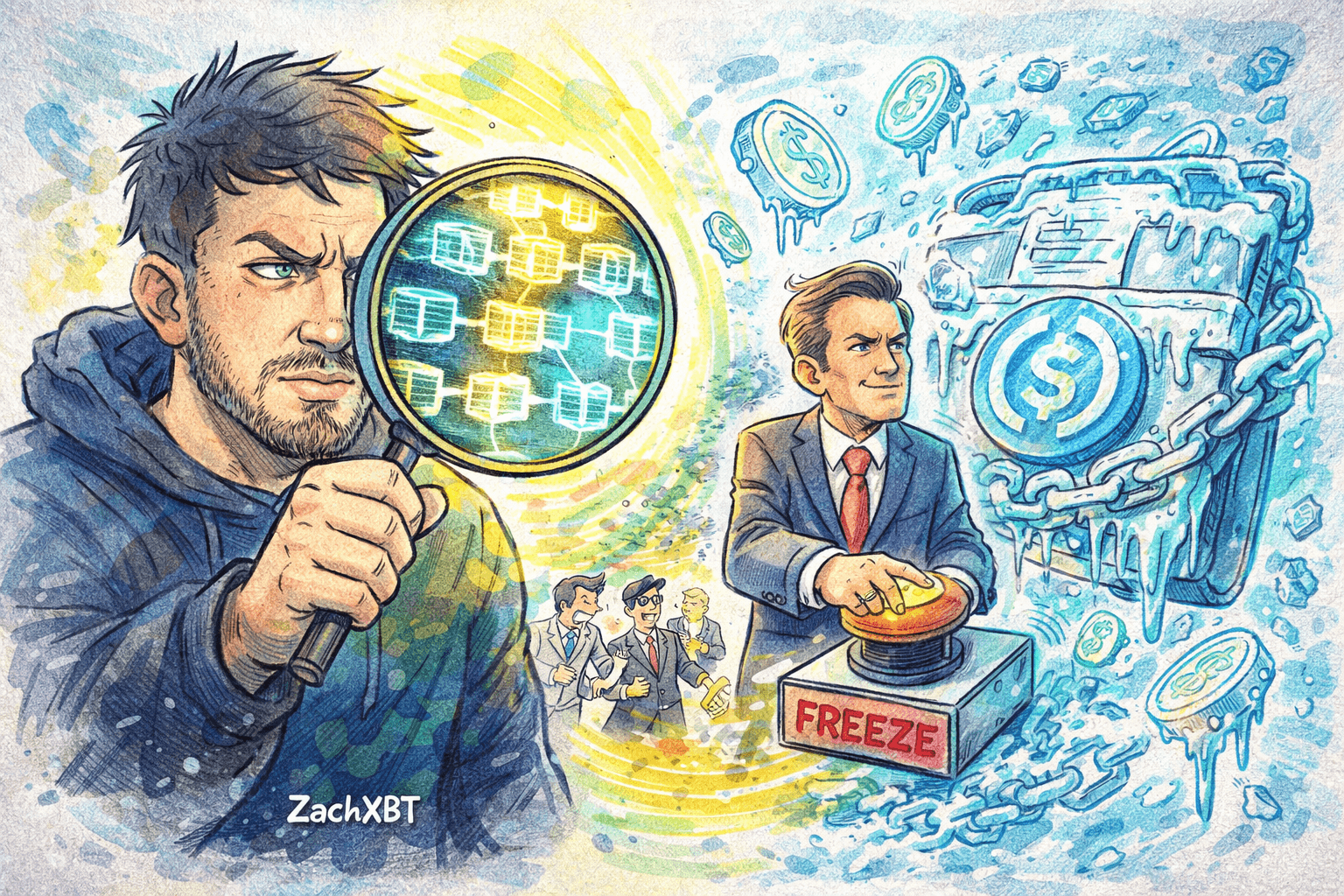
Blockchain Investigator Criticizes Circle Over Wallet Freeze
Prominent blockchain investigator ZachXBT has accused stablecoin issuer Circle of incorrectly freezing certain cryptocurrency wallets, reigniting debate over centralized control within supposedly decentralized financial systems.
The allegation surfaced after ZachXBT claimed that Circle froze exchange wallets tied to activity that may not have warranted enforcement action. The situation has triggered renewed scrutiny of how stablecoin issuers handle compliance enforcement across blockchain networks.
The controversy surrounding the ZachXBT Circle wallet freeze highlights the complex balance between regulatory compliance and decentralization principles within the cryptocurrency ecosystem.
While many blockchain projects emphasize decentralization, stablecoin issuers often maintain centralized authority over key functions, including the ability to freeze funds under certain circumstances.
Who Is ZachXBT?
ZachXBT is a well-known independent blockchain investigator who has built a reputation for tracking illicit crypto activity and exposing scams within the digital asset industry.
Operating largely through social media and on-chain analysis, ZachXBT has uncovered numerous fraud schemes, stolen funds, and suspicious transactions across various blockchain networks.
His investigations frequently rely on public blockchain data and transaction tracing techniques.
For readers interested in how investigators analyze blockchain activity, a guide to blockchain transaction tracing and onchain analysis explains how analysts can follow digital asset movements through transparent public ledgers.
Because blockchain networks record every transaction publicly, skilled investigators can often identify patterns of activity even when participants attempt to obscure their identities.
Why Stablecoin Issuers Can Freeze Funds
The controversy over the ZachXBT Circle wallet freeze stems from the centralized controls embedded within certain stablecoin systems.
Unlike decentralized cryptocurrencies such as Bitcoin, many stablecoins include administrative functions that allow the issuing organization to intervene in exceptional circumstances.
Circle, the issuer of the USDC stablecoin, can freeze tokens held in specific wallets if required to comply with legal orders or regulatory investigations.
This capability is designed to prevent the use of stablecoins for illicit activities such as money laundering or fraud.
A deeper explanation of how stablecoins maintain regulatory compliance shows why many issuers incorporate compliance tools into their token contracts.
However, these same controls also raise questions about how much authority centralized entities should have within decentralized financial ecosystems.
The Debate Over Centralized Control
The ZachXBT Circle wallet freeze dispute has intensified a long-running debate within the crypto community.
Supporters of strict compliance measures argue that freezing capabilities are necessary for preventing criminal activity and maintaining trust in digital asset markets.
Without such mechanisms, stablecoins could potentially become tools for large-scale financial crimes.
Critics, however, argue that centralized intervention undermines one of the core principles of cryptocurrency: financial autonomy without intermediaries.
Stablecoins occupy a unique position between traditional finance and decentralized blockchain systems.
Understanding how stablecoins function within crypto markets helps explain why these assets often operate under stricter oversight than other cryptocurrencies.
This hybrid structure can create tension between regulatory compliance and decentralization ideals.
Exchange Wallets and Compliance Challenges
The wallets involved in the ZachXBT Circle wallet freeze controversy were reportedly connected to exchange infrastructure rather than individual users.
Crypto exchanges often manage large pools of funds on behalf of their customers, making compliance enforcement more complex.
If regulators flag suspicious activity tied to an exchange wallet, freezing the wallet can inadvertently affect multiple users whose funds are pooled within the same address.
This dynamic illustrates one of the challenges facing crypto compliance enforcement.
Blockchain networks provide transparency, but the operational structures of exchanges and custodial platforms can complicate enforcement actions.
Investigators and regulators must therefore carefully analyze transaction flows before determining whether enforcement actions are justified.
Stablecoins Play a Critical Role in Crypto Markets
Stablecoins like USDC have become essential infrastructure within the cryptocurrency ecosystem.
They serve as a bridge between traditional financial systems and digital asset markets, allowing traders to move funds quickly between exchanges without relying on bank transfers.
Stablecoins are also widely used within decentralized finance platforms for lending, liquidity provision, and collateralization.
Because of this central role, enforcement actions involving stablecoins often attract significant attention from the crypto community.
The USDC wallet freezing debate demonstrates how decisions made by stablecoin issuers can have far-reaching consequences across the broader market.
Regulatory Pressure Is Increasing
The ZachXBT Circle wallet freeze controversy also reflects the broader regulatory environment surrounding stablecoins.
Governments and financial regulators around the world are paying closer attention to stablecoin issuers because of their growing role in global financial markets.
Authorities are particularly concerned about ensuring that stablecoins are not used for illicit activities or financial manipulation.
Regulators are also evaluating whether stablecoin issuers should be subject to banking-style oversight.
These discussions form part of the wider stablecoin regulation debate, which could shape how digital asset markets operate in the coming years.
Transparency vs Enforcement
The situation involving ZachXBT and Circle highlights a fundamental tension in the cryptocurrency ecosystem.
On one hand, blockchain transparency allows investigators and analysts to identify suspicious activity and track illicit funds.
On the other hand, enforcement actions carried out by centralized entities can sometimes raise concerns about fairness and accountability.
Balancing transparency, compliance, and decentralization remains one of the most complex challenges facing the cryptocurrency industry.
As digital asset markets continue evolving, the relationship between centralized institutions and decentralized technology will likely remain a subject of ongoing debate.
Conclusion
The ZachXBT Circle wallet freeze dispute underscores the difficult balance stablecoin issuers must maintain between regulatory compliance and the decentralized ethos of cryptocurrency.
While enforcement mechanisms such as wallet freezing are designed to prevent illicit activity, they also highlight the degree of control centralized organizations maintain over certain blockchain-based assets.
As stablecoins continue playing a critical role in digital finance, debates around USDC wallet freezing, compliance authority, and decentralized governance are likely to remain central issues within the cryptocurrency industry.