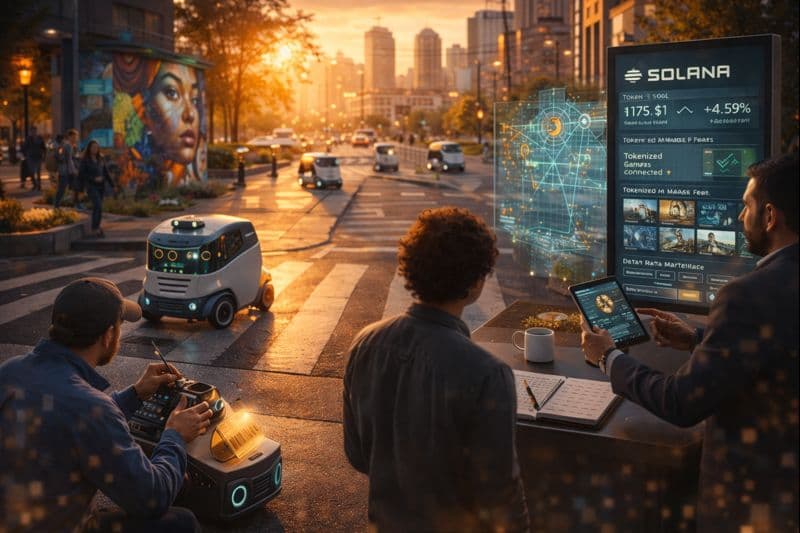
A New Kind of Network: Cameras, Bots and Blockchain
Imagine a world where cameras everywhere—on drones, vehicles, street corners, and even backpacks—collect real-world data and earn crypto for doing so. That’s the idea behind a fresh experiment in decentralized physical infrastructure (DePIN) emerging on the Solana blockchain.
This project isn’t just another DeFi play or NFT collectible. Instead, it aims to weave together robotics, decentralized hardware, and real-world data markets in a way that rewards people for deploying and operating devices that gather useful information. The core concept is simple but ambitious: build a self-driving camera network that anyone can join, and use crypto tokens as incentives to power participation and data exchange.
In traditional systems, sensor or data networks are owned and controlled by a single company, and the value flows to that company. But DePIN flips that model. By embedding incentives and governance on-chain, it aims to create a shared, open infrastructure where individuals and small operators can benefit directly from the value they help generate.
How It Works: Robots With Purpose
At the heart of this initiative are autonomous vehicles—not the full self-driving cars of sci-fi fame, but smaller, adaptable robots equipped with cameras and sensors that can move around and collect information. Participants host and operate these systems, and the network uses a blockchain-based protocol to:
Verify and index sensory data on-chain.
Reward operators with tokens for useful contributions
Allow data consumers to access data through smart contracts
Create a decentralized marketplace for real-world data
This marketplace isn’t just about images and video. It can include environmental data, movement patterns, infrastructure status, and any number of supported sensor streams. Think of it like a decentralized network of “eyes and ears” that can be tapped by applications whether for city planning, environmental monitoring, robotics optimization, logistics, or even augmented reality experiences.
Instead of paying a subscription to a central provider, data consumers pay into smart contracts that release incentives to operators who contribute the most relevant or high-quality data.
Why Solana?
Solana is attractive for this kind of project for a few reasons. Its throughput and low transaction costs make it easier to update thousands of microtransactions like verified data contributions without crushing fees. Solana’s decentralized ecosystem also has a history of supporting experimental infrastructure and performance-oriented protocols, which fits well with the real-time nature of sensor networks.
By building on Solana, this project hopes to avoid the bottlenecks that would make such an ambitious real-world data architecture impractical on slower or more expensive networks.
Beyond Cameras: Toward a Data Economy
The implications go beyond robotics and cameras. If a decentralized network of real-world data producers can scale with operators around the world earning tokens for their contributions, you end up with a new type of digital economy.
Here’s how that could ripple outward:
Cities and researchers can access real-time environmental or traffic data without relying on a single vendor.
Developers build apps that tap verified, timestamped sensor feeds for augmented reality, mapping, or digital twins of physical places.
Operators earn proportional rewards for valuable contributions, democratizing who benefits from data collection.
Instead of infrastructure being owned by a handful of corporations, a global network of individual contributors co-owns the fabric of the system. That’s the promise, and also the challenge.
Challenges: Complexity Isn’t Cheap
This sort of system sounds great in concept, but reality has a few hurdles:
Hardware Costs & Maintenance: Robots and camera sensors aren’t free. Ensuring that operators can earn enough to justify their investment is essential.
Data Quality Control: Not all data is equal. Systems must be smart enough to reward useful data while filtering noise, duplicates, or irrelevant feeds.
Safety & Regulations: Self-driving robots, especially outside controlled environments, bring up concerns about public safety, privacy, local laws, and liability.
Market Liquidity: A decentralized data marketplace needs demand. Without enough consumers willing to pay for feeds, incentives may dry up.
These challenges aren’t trivial, and the project’s long-term success will depend on practical adoption and community buy-in.
Why It Matters for Crypto’s Future
It’s easy to brush off DePIN headlines as buzzwords. But when you step back, what’s happening here points to something deeper: the idea that blockchains can coordinate real-world systems, not just finances.
For much of crypto’s history, success stories were about digital scarcity, tokens, yield, and virtual community. DePIN extends that logic into the physical world, rewarding contributions to infrastructure that interacts with our physical environment.
If you’ve ever thought about crypto as a “digital overlay” on the real world, this is exactly what proponents mean: provably shared infrastructure with economic incentives, built and governed without a central owner.
That’s a shift from “let’s build financial products on-chain” to “let’s build real physical stuff together, and use crypto to make it fair.”