Nasdaq’s Tokenization Push Raises Market Questions
Nasdaq’s growing interest in blockchain-based financial infrastructure is fueling debate about how tokenization could reshape global equity markets.
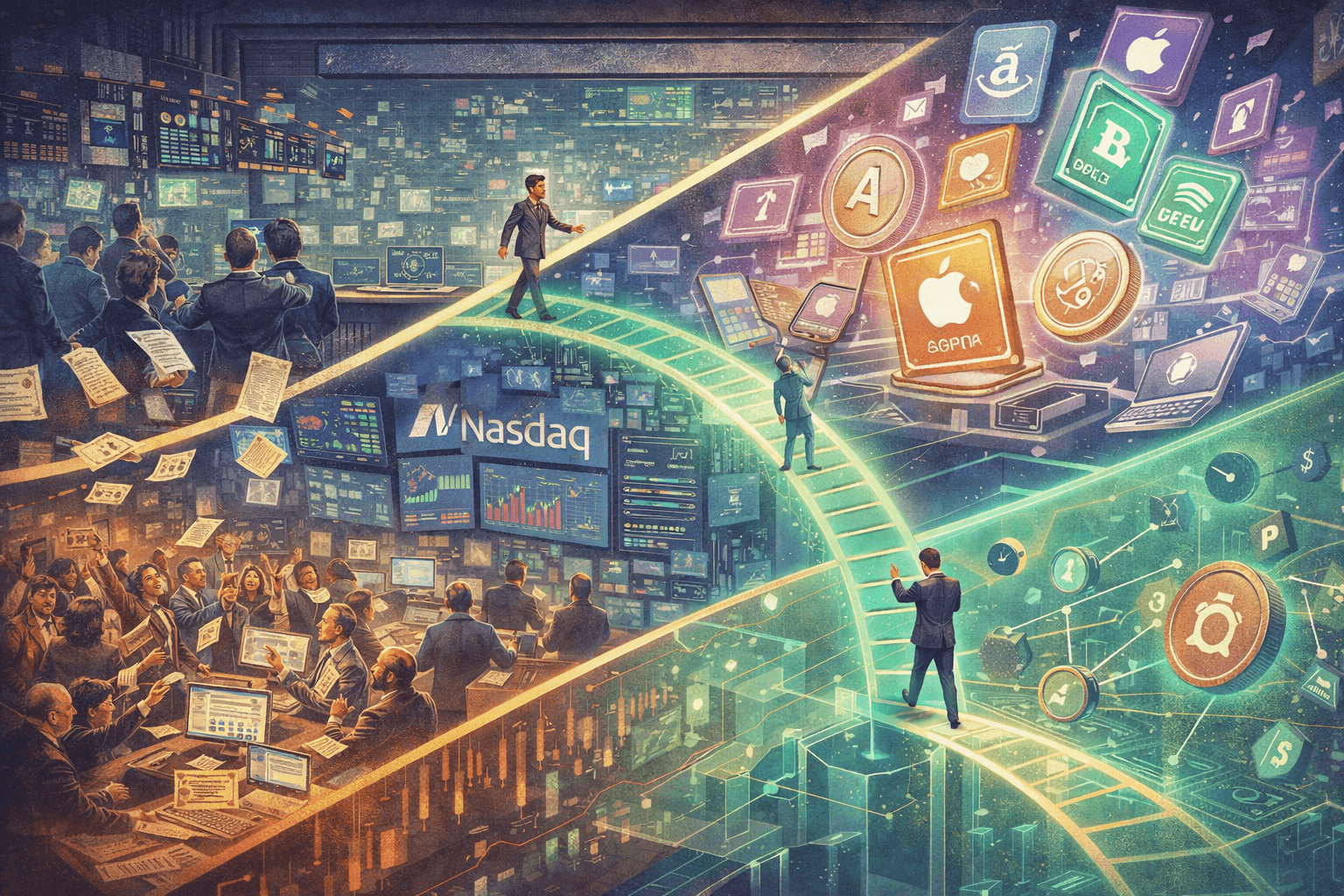
According to recent analysis, the Nasdaq tokenization strategy could eventually create two parallel trading environments: traditional stock exchanges operating within existing systems and new blockchain-based markets where tokenized securities trade continuously.
Tokenization allows financial assets such as stocks to be represented digitally on blockchain networks. These tokenized versions can potentially be traded outside the conventional trading hours and settlement processes that govern traditional markets.
As the industry experiments with these technologies, analysts are evaluating how tokenized stock trading might influence market structure in the future.
What Tokenized Stocks Are
Tokenized stocks are blockchain-based tokens that represent shares in publicly traded companies.
Instead of buying shares through a brokerage account, investors hold tokens representing those shares within a digital wallet.
These tokens can mirror the value of the underlying asset and may allow investors to trade securities using blockchain infrastructure.
For readers exploring the mechanics behind this concept, asset tokenization on blockchain networks explains how real-world financial instruments can be represented digitally on distributed ledger systems.
Tokenization could potentially modernize stock trading by enabling faster settlement and greater accessibility for global investors.
Why Nasdaq Is Exploring Tokenization
Nasdaq has increasingly explored blockchain technology as part of its broader strategy to modernize financial market infrastructure.
Traditional equity markets rely on complex systems involving exchanges, clearinghouses, and custodians.
These systems can sometimes require multiple days to settle trades.
Blockchain infrastructure could simplify this process by recording transactions directly on distributed ledgers.
Understanding how blockchain technology supports financial infrastructure helps explain why major exchanges are studying these systems.
Tokenization could reduce settlement times and improve transparency across capital markets.
The Nasdaq tokenization strategy reflects growing interest in these potential efficiencies.
Could Markets Split Into Two Systems?
Analysts have suggested that tokenization could eventually create two parallel versions of financial markets.
On one side would be traditional exchanges operating under existing regulatory frameworks and market hours.
On the other side would be blockchain-based trading systems where tokenized stock trading occurs continuously.
This structure could resemble the relationship between traditional finance and cryptocurrency markets today.
Traditional markets operate within fixed schedules, while blockchain-based platforms function around the clock.
The development of blockchain capital markets could therefore reshape how investors access financial assets.
Advantages of Blockchain-Based Trading
Proponents of tokenized markets argue that blockchain systems offer several advantages over traditional trading infrastructure.
Potential benefits include the following:
faster trade settlement
lower operational costs
fractional ownership of assets
global accessibility for investors
Blockchain networks can also provide transparent records of transactions, which may improve auditing and compliance processes.
For readers interested in the technical foundation of these systems, how blockchain ledgers record financial transactions explains how distributed networks store transaction histories securely.
These features have driven interest in digital securities infrastructure among financial institutions.
Regulatory Challenges Remain
Despite the promise of tokenized markets, regulatory challenges remain significant.
Stock markets operate under strict legal frameworks designed to protect investors and maintain orderly trading.
Any new system involving tokenized securities must comply with these rules.
Regulators must determine how blockchain-based trading platforms should be supervised and how investor protections will be enforced.
Questions also remain about custody, settlement guarantees, and cross-border trading regulations.
Because of these challenges, the transition toward blockchain capital markets will likely occur gradually.
Institutional Interest in Tokenized Finance
Large financial institutions have shown growing interest in tokenization.
Banks, asset managers, and exchanges are experimenting with blockchain-based systems designed to support digital securities.
These initiatives aim to modernize capital markets while maintaining regulatory compliance.
The Nasdaq tokenization strategy represents one example of how traditional financial infrastructure providers are adapting to the digital asset era.
As technology evolves, tokenized assets may become an increasingly common feature of global financial markets.
The Future of Stock Trading Infrastructure
Tokenization could represent one of the most significant technological shifts in financial markets since the transition to electronic trading.
If blockchain infrastructure proves capable of supporting large-scale trading activity, the structure of stock markets may gradually evolve.
Some analysts believe tokenized markets could coexist alongside traditional exchanges for many years.
Others argue that blockchain systems may eventually replace certain components of existing financial infrastructure.
Regardless of the outcome, developments in digital securities infrastructure will likely play a major role in shaping the future of global capital markets.
Conclusion
Nasdaq’s exploration of blockchain technology highlights the growing importance of tokenization in modern finance.
The Nasdaq tokenization strategy reflects a broader movement toward digital asset infrastructure that could transform how securities are issued and traded.
If tokenized markets continue developing, the future of equity trading may involve a hybrid system where traditional exchanges operate alongside blockchain-based platforms.
As tokenized stock trading expands, financial institutions, regulators, and investors will need to adapt to the evolving structure of global capital markets.