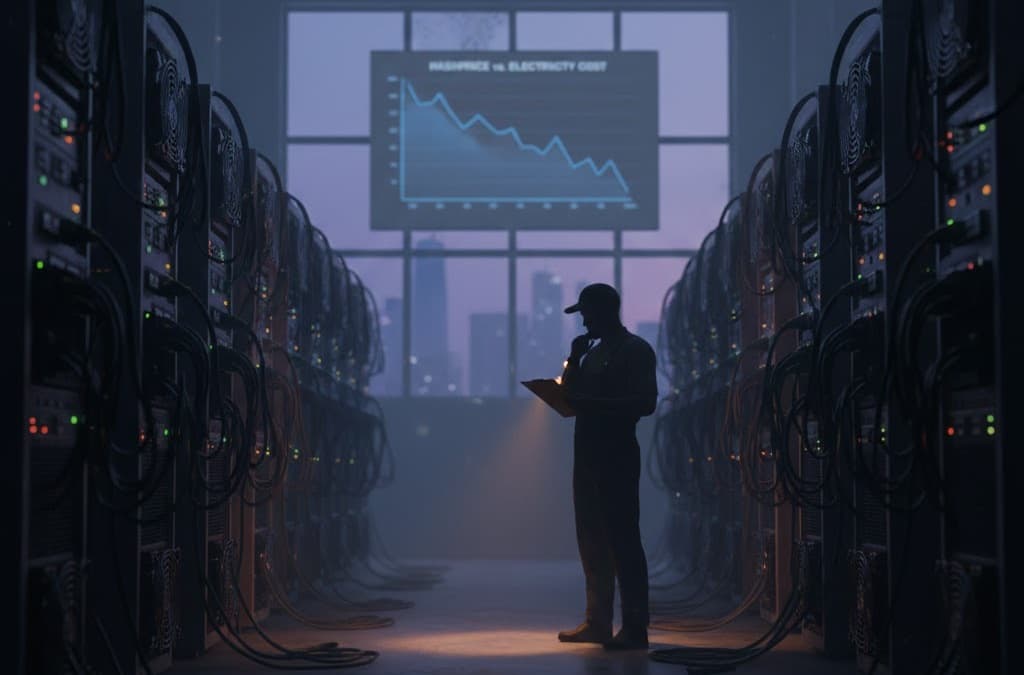
A Sudden Freeze: Why Rigs Are Shutting Down
In recent months, mining farms around the world have begun unplugging machines. The reason? It’s no longer worth keeping them on. For many, even brand-new rigs are bringing in less money than the electricity and maintenance they consume.
At the heart of the problem is a steep collapse in “hashprice,” the daily revenue miners earn per unit of computing power. As hashprice falls, revenue shrinks even while costs remain high. Meanwhile, network-wide mining difficulty and hashrate remain elevated, pushing competition up and rewards down. This means that miners must expend more computing power and energy just to mine the same amount of Bitcoin.
For rigs that aren’t ultra-efficient or operating under very cheap energy contracts, this combination is deadly. When the expected returns fall below break-even or hover dangerously close, the rational decision for many operators becomes: power down rather than bleed money.
New Rigs? Doesn’t Always Help
One might assume that newer, more efficient ASICs would survive such a downturn. But even they aren’t immune, and here’s why:
Elevated network difficulty & high hashrate: As more rigs (and more advanced ones) come online, the competition intensifies. This pushes mining difficulty higher, meaning each miner’s share of block rewards shrinks. Even efficient rigs now have to work harder for fewer coins.
Hashprice collapse outweighs efficiency gains: The hashprice slump driven by lower crypto-market sentiment, weaker transaction-fee income, or downward pressure on BTC prices reduces total revenue per hash. Efficiency helps, but if revenue per hash drops too far, even top-tier rigs struggle.
Rising operating costs: Energy prices, cooling, infrastructure, and debt servicing add up. If power costs are not extremely low, or if rigs are run in regions with expensive energy or poor efficiency, profitability gets squeezed.
Long payback periods: For many setups, the time to recoup capital investment (cost of rigs + setup) has stretched far, sometimes making it unrealistic in current conditions.
Thus, modern hardware alone no longer guarantees profitability.
Who’s Getting Hit, and Who Might Stay On
This shutdown trend doesn’t hit every miner equally. The pressure is most intense on:
Smaller-scale miners using standard rigs and expensive energy, who don’t have the economies of scale to absorb losses.
Operators with older or mid-tier rigs that lose their edge as difficulty rises, even if they plug in newer equipment, may still find the break-even point out of reach.
Those with a chance of surviving:
Large-scale farms with access to ultra-cheap power (renewables, subsidized energy, or regions with low electricity costs).
Operators willing to pivot by suspending mining operations for now, waiting for favorable network or price conditions, or diversifying into other uses (e.g., repurposing infrastructure).
Miners in regions with supportive infrastructure and regulatory environments, who can maintain lower overheads and are more resilient to market swings.
What This Means for the Broader Bitcoin Network
The trend of rigs being switched off across both old and new hardware carries consequences beyond the bottom line of miner balance sheets:
Possible drop in total network hashrate: As rigs go offline, overall computing power securing the network may shrink, potentially slowing block-production speed until difficulty adjusts.
Increased centralization risk: If only well-funded, power-cheap large farms survive, mining could become more centralized, reducing the decentralization that many view as the core ethos of Bitcoin.
Sell pressure from miners: Under financial stress, some miners might liquidate their BTC holdings or equipment, adding downward pressure to market supply.
Mining sector strategizing: The shake-out could accelerate a shift from pure mining to diversified infrastructure, e.g., data centers, AI compute centers, or energy-efficient operations, as operators hedge against volatility.
Why This Moment Feels Different
This isn’t a typical cyclical dip. The convergence of a steep hashprice collapse, high network difficulty, elevated energy and infrastructure costs, and macroeconomic headwinds means profitability even with strong rigs is under structural stress. For many, this isn’t a temporary lull: it’s a wake-up call.
The pause in mining, the shutdown of rigs, and the resulting rethinking of business models suggest a deeper shift: from a boom-oriented mining industry to one where efficiency, scale, diversification, and capital strength determine survival.
For the broader community of investors, network participants, and onlookers, this shake-out could reduce mining supply pressure, change the mix of who secures the network, and alter long-term dynamics of Bitcoin’s infrastructure.